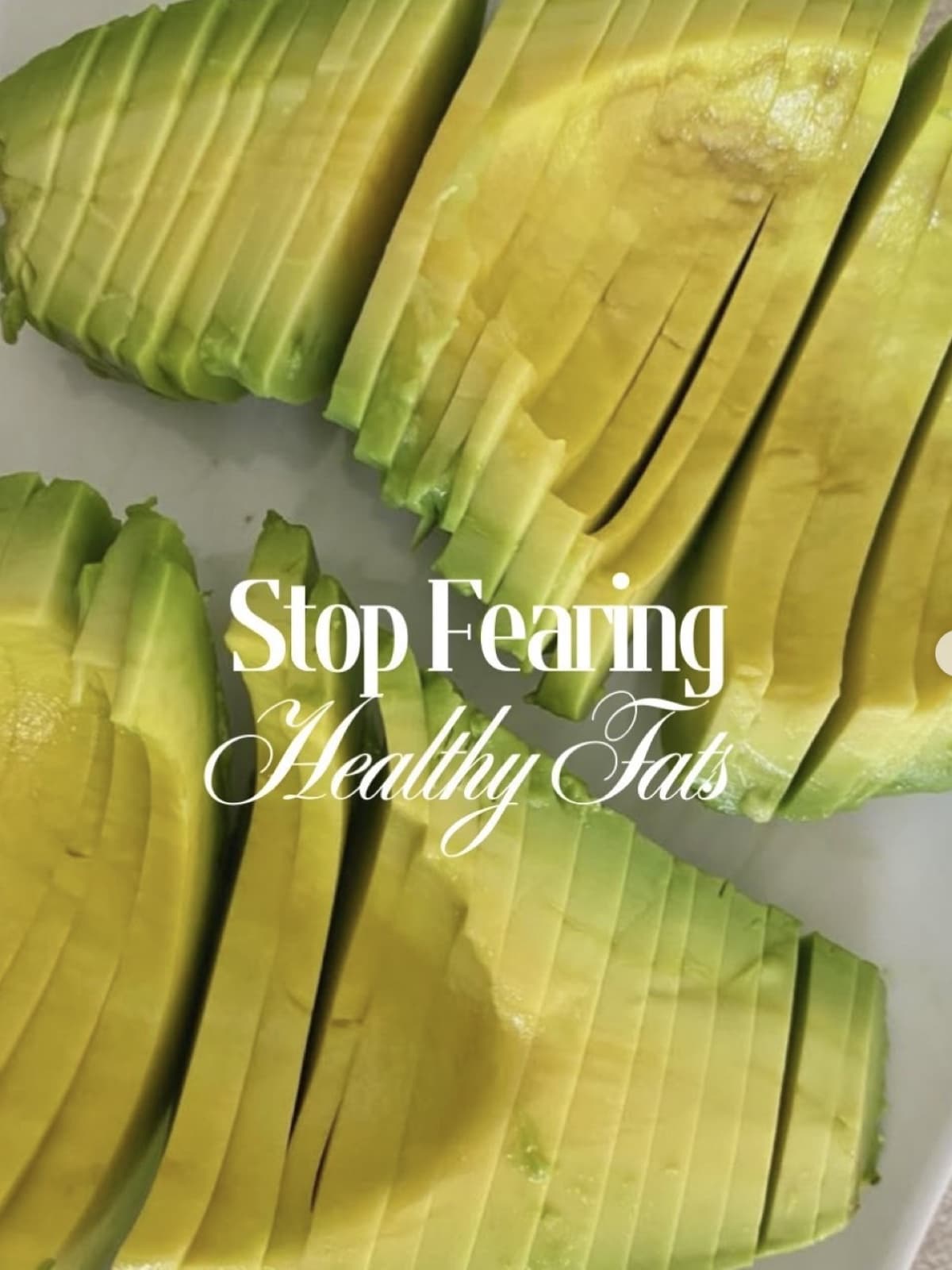
Eating fat doesn't make you fat. You don't store fat because you eat fat. You store fat because of insulin spikes and hormonal imbalance.
Two generations of dietary advice got this wrong, and the residue is still everywhere — in the low-fat yoghurt aisle, in the reflex to scrape the avocado back off, in the vague sense that olive oil is something to be careful with.
The mechanism is straightforward. Fat has almost no direct effect on insulin. Refined carbohydrate does. And insulin is the hormone that determines whether energy gets stored.
More usefully: fat eaten alongside carbohydrate slows the whole meal down. Same food, gentler glucose curve, smaller insulin response. Fat isn't neutral in this equation — it's actively helping.
The hormone case
This is the part that matters most, and the part that almost never gets said.
Estrogen and progesterone thrive when cortisol and insulin are calm. And one of the most effective ways to regulate both? Fat.
Steroid hormones — estrogen, progesterone, testosterone, cortisol — are synthesised from cholesterol. Not metaphorically. Structurally. Sustained very low fat intake removes the raw material the whole system is built from, which is a substantial part of why aggressive low-fat dieting so often produces irregular cycles.
Three specific claims from her post, each with a different mechanism:
Omega-3s calm inflammation — particularly supportive for PMS and skin. This is the one with the strongest evidence behind it and the one most people are shortest on.
Avocados and olive oil support progesterone production. Monounsaturated fat, and the luteal phase is where you'll notice its absence.
Saturated fats like ghee and egg yolks support healthy estrogen metabolism. The most counter-cultural line on the page, and worth stating plainly rather than hedging: some saturated fat, from whole-food sources, in an otherwise good diet, is not the enemy it was made into.
The three groups
The distinction that matters is not saturated versus unsaturated. It's whole-food fat versus industrially processed fat. Egg yolks and a fried snack in refined seed oil are not the same category of thing, and grouping them together is how the original advice went wrong.
Where it shows up first
Fat intake is unusually legible in three places, and they're often the first things to change:
Skin. Your barrier is built from lipids. Persistent dryness that no cream fixes is very often a dietary fat problem wearing a skincare costume.
Your cycle. Irregularity, worsening PMS, a difficult luteal phase. Fat is upstream of all three.
Satiety. Fat is the most satiating macronutrient per gram. A low-fat meal leaves you looking for something ninety minutes later, and then that gets read as a discipline problem.
How much
No number, deliberately. But the practical version:
- Something with fat in it at every meal
- Half an avocado, a tablespoon of olive oil, a handful of nuts, a spoon of tahini — any of them counts
- Omega-3 sources daily rather than occasionally, because that's the one most diets genuinely lack
- Buy the full-fat version of things that come in both
If you've been eating low-fat for years, this will feel like too much for about a fortnight. It isn't.
Where people go wrong
- Choosing the low-fat version. The fat is usually replaced with sugar or starch, which is the thing that actually spikes insulin.
- Eating carbohydrate naked. Fat, protein or fibre alongside changes the metabolic outcome of the identical food.
- Fearing egg yolks. The yolk is where the nutrition is. This one is settled and the reflex persists anyway.
- Confusing whole-food saturated fat with processed fat. Ghee and a fried snack are not the same category.
- Cutting fat while trying to fix dry skin. Your barrier is made of lipids. You are removing the ingredient.
- Very low fat during the luteal phase, which is precisely when progesterone most needs the raw material.
The one thing
Half an avocado, or a proper tablespoon of olive oil, with your next carbohydrate-heavy meal.
Same meal, flatter curve, more satiety, and one of the easiest structural swaps available. You are not adding a problem. You are removing one.