This guide is about telling two ordinary things apart so you can stop worrying about one of them. It is not a weight-loss protocol and there are no targets in it on purpose.
If food, your body or the mirror has become a source of daily distress, that's worth talking to someone about — and it matters far more than anything on this page.
At six in the evening your stomach looks different from how it looked at eight in the morning, and somewhere in between you decided something had gone wrong.
Almost certainly nothing did.
Bloating is a temporary message. Fat is long-term storage. You probably did not gain fat overnight.
Fat is built slowly, from a sustained pattern, over weeks and months. Bloating arrives in an afternoon and leaves by morning. They feel identical in a fitting room and they are not remotely the same event.
Why bloating happens
Six causes cover almost all of it, and only one of them is about food sensitivity — which is where most people start looking.
| Cause | What it does |
|---|---|
| High cortisol | Slows digestion and increases water retention |
| Low progesterone | More PMS bloating, reliably, in the same week each month |
| Higher estrogen | Water retention |
| Food sensitivities or gut irritation | Gas and irritation |
| Large meals | Temporary stomach distension — mechanical, not metabolic |
| Highly processed foods | Inflammation |
Three of those six are hormonal. If your bloating has a rhythm to it — worse in week four, better after your period starts — you're not reacting to a food. You're reading your cycle.
Why fat is stored
Also unglamorous, also mostly not about willpower.
- Consistently eating more than you use, over a long period
- Frequent large blood sugar spikes
- Poor sleep, which increases hunger and cravings the following day
- Cortisol overload, which influences both eating behaviour and where fat is distributed
- Low daily movement — fewer calories burned across the whole day, not in the gym
Notice how many of those are sleep and stress rather than food. That's not a coincidence, and it's why "eat less, move more, harder" so often stalls.
The bloating cheat sheet
Her list, unchanged, because it's the right list. None of it requires cutting a food group.
- Eat slowly — less swallowed air, which is a bigger contributor than people expect
- Cooked vegetables over raw while things are settling. Salads cost more digestive effort.
- Limit processed food, sugar, sugar alcohols, artificial sweeteners and soda. Sugar alcohols in particular — the ones ending in -ol on a label — are a common and unsuspected cause.
- One tea a day, peppermint for preference
- Manage stress — meditation, journaling, anything that genuinely lowers cortisol rather than distracting from it
- Two litres of water, with electrolytes. Water alone can make retention worse.
- Walk, stretch or move after meals
- Avoid eating far past fullness
- Support your microbiome — whole foods, fruit and vegetables, fermented foods, probiotic-rich foods
That last one is the long game. The rest work within days.
The other cheat sheet
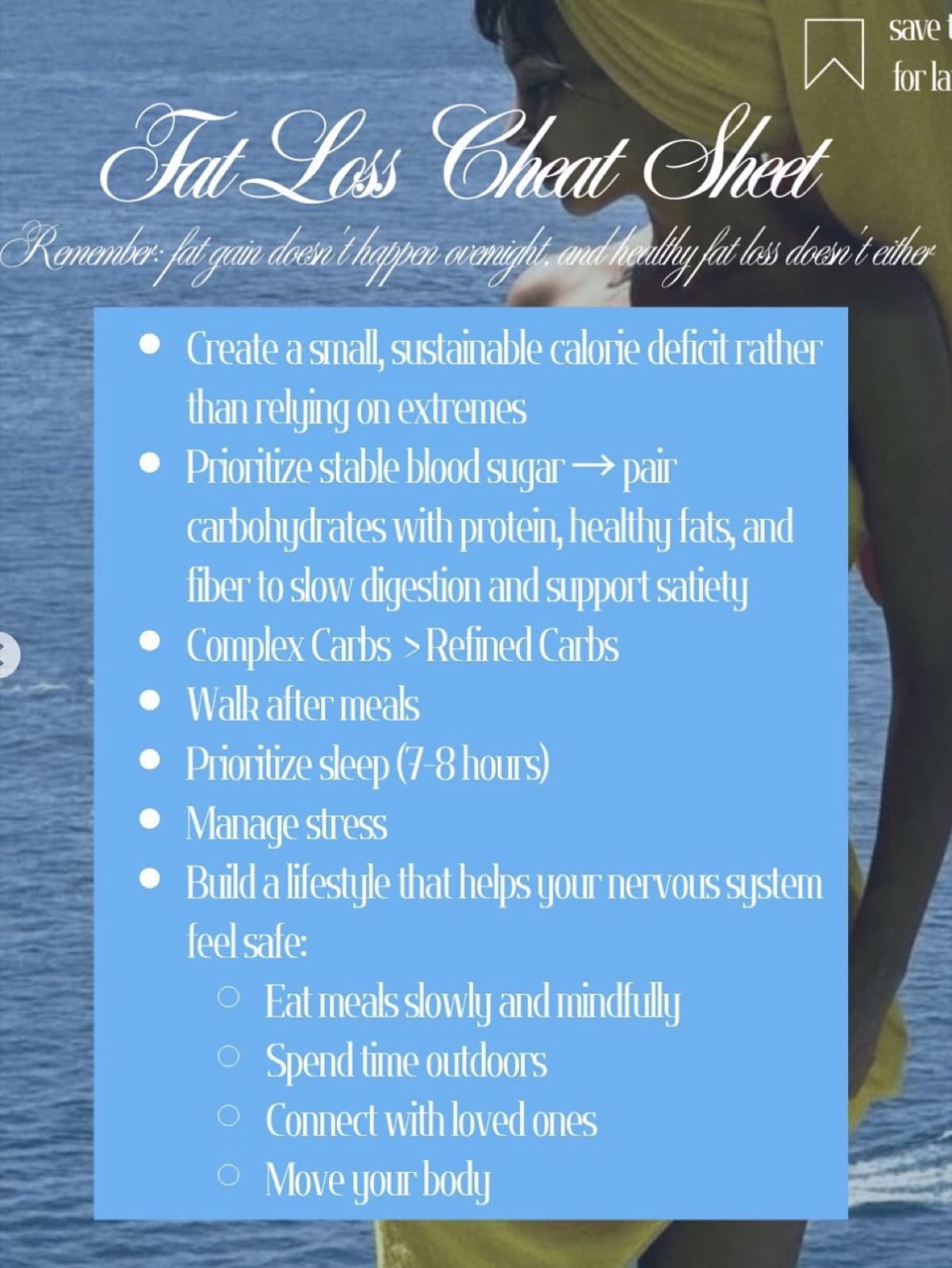
Fat loss is not about starving. It's about steady blood sugar, calm hormones, daily movement, and eating a bit less over time.
- A small, sustainable adjustment rather than an extreme one
- Prioritise stable blood sugar — pair carbohydrates with protein, healthy fats and fibre
- Complex carbohydrates over refined ones
- Walk after meals
- Sleep seven to eight hours
- Manage stress
- Build a life your nervous system reads as safe — eat slowly and mindfully, get outdoors, see people you love, move your body
The last point is the one that looks softest and does the most work. A body that feels chronically unsafe holds on to things. That is not a metaphor.
Where people go wrong
- Reading bloating as fat gain, then eating less — which raises cortisol, which slows digestion, which increases the bloating.
- Cutting out a food group on the strength of one bad evening. Give it two weeks and a pattern before you conclude anything.
- Drinking more water without electrolytes when already retaining. It can make it worse.
- Loading up on raw vegetables during a bad week because they feel virtuous.
- Checking the mirror at six in the evening and comparing it to eight in the morning. Those are different bodies at different points in a day, and always will be.
- Never noticing the monthly rhythm. Track it for two cycles and half of this stops being mysterious.
The one thing
For one week: eat slowly, walk ten minutes after dinner, and switch raw vegetables for cooked.
Nothing removed, nothing counted. If the bloating settles, you've learned it was digestion and stress rather than anything you need to eliminate — and that knowledge is worth more than the week.